

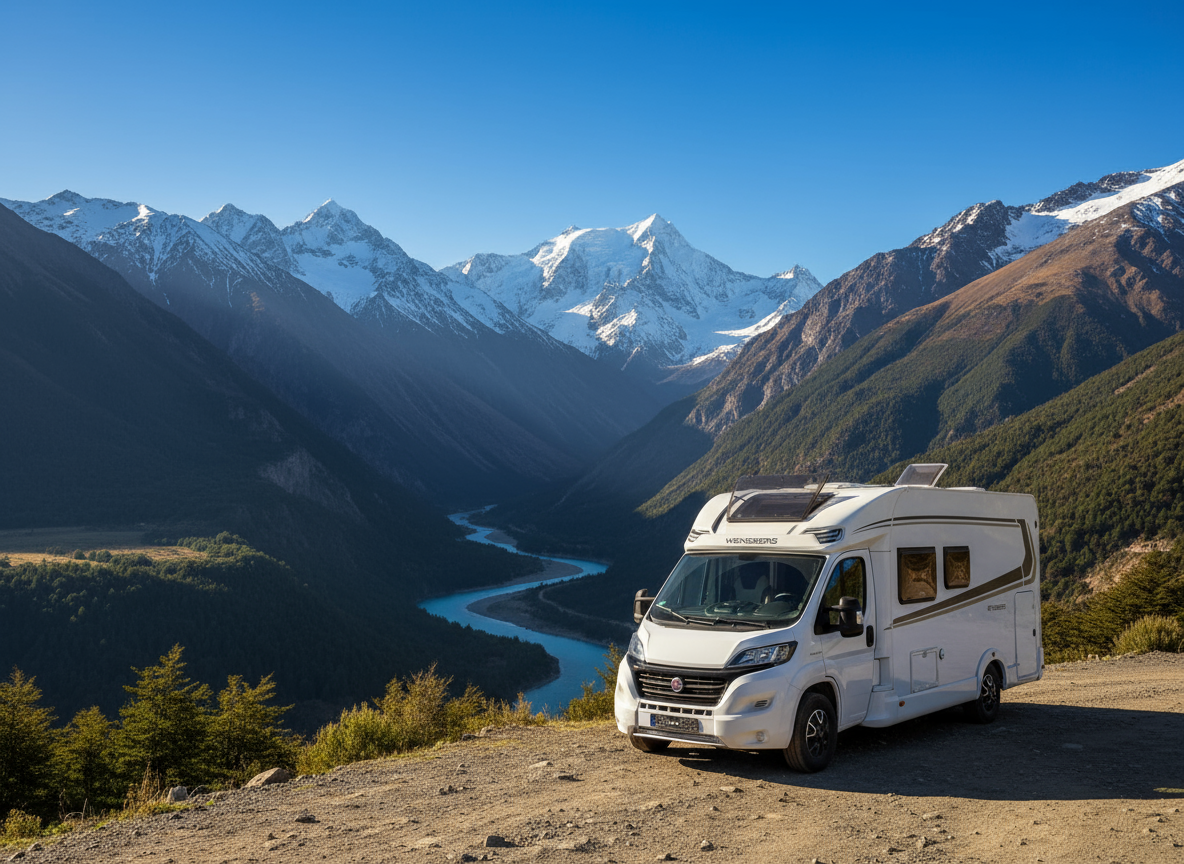
Motorhome, camper, casa rodante and van: the real differences and which to choose
If you are thinking of traveling Chile or the world on four wheels, you have probably run into a curious confusion: motorhome, autocaravana, camper, campervan, van, casa rodante, RV, caravan… are they all the same?
The short answer is: not exactly.
The problem is that these terms do not necessarily mean the same thing in every country. A word that in Spain names a specific kind of vehicle can be used much more broadly in the United States or Chile.
In this article we explain the real differences between the main types of recreational vehicles and, above all, the advantages and disadvantages of each one for travel.
First: what does “motorhome” actually mean?
The English word motorhome could be translated literally as “a house with a motor.”
And that translation is a useful clue: it is a vehicle that combines the means of transport and the living space in a single unit.
Unlike a caravan, you do not need a separate car to tow it.
A motorhome can have:
a bed or beds
Kitchen
a dinette
storage
Heating
fresh water and waste water
a bathroom and a shower
an electrical system
a refrigerator
living space
But this is where the first big international difference appears.
In the United States, the term RV (Recreational Vehicle) is much broader. The US industry mainly splits RVs into motorized vehicles (motorhomes) and vehicles that need to be towed (towable RVs). Among those are travel trailers, fifth wheels, pop-up trailersANDtruck campers.
In Europe, by contrast, we usually talk about motorhome, autocaravana, Wohnmobil or camping-car to mean self-propelled vehicles meant for travel and overnight stays.
That is why, before comparing terms, it helps to understand that the terminology changes from country to country.
1. Campervan: the motorhome that is still a van
The campervan is probably one of the most popular vehicles in the world of van life.
The idea is simple:
Take a conventional van and turn the inside into a small living space.
Well-known examples include the Volkswagen Transporter, Ford Transit, Mercedes-Benz Vito/Sprinter, Fiat Ducato, Peugeot Boxer, Citroën Jumper and many others.
Depending on the model and how it is fitted out, a campervan can have:
a bed
Kitchen
a fridge
storage
an auxiliary battery
solar panels
Heating
a pop-top roof
Shower
WC
a dinette
The smallest campervans can be surprisingly simple. Some have only a bed and a small kitchen module, while others have practically everything you need to live independently for several days.
The main advantage?
Its size.
A campervan can be used both for travel and for getting around a city, parking more easily and driving narrow roads.
In Germany, for example, people usually distinguish between Campingbus o CampervanANDKastenwagen. The first are usually more compact vehicles, while the second are normally larger panel vans converted into live-in vehicles.
Ideal for:
couples
short trips and getaways
travelers who also want to use the vehicle in everyday life
people who put mobility and ease of driving first
trips where you will spend a lot of time outside the vehicle
Its main disadvantage
The interior space.
A van has a relatively narrow body and, however well you use every centimeter, the available space will always be limited.
2. Van: be careful, because “van” does not necessarily define a type of motorhome
This is one of the most common confusions.
Van simply means a panel van in English.
So when someone says “I’m going to travel in a van,” they might mean a small campervan, a fully equipped Mercedes Sprinter, or even a van with almost no equipment.
In the world of van life, however, “van” is often used as a short way of saying campervan.
Therefore:
Van ≠ necessarily campervan.
A van is the base vehicle.
A campervan is a van that has been fitted out for travel and overnight stays.
3. Camper: one of the most confusing words in the motorhome world
If one word causes confusion, it is probably camper.
Why?
Because its meaning changes a great deal from country to country.
In Spain, when someone talks about “a camper,” they usually mean a camperized van.
In Italy, camper it can be used directly to mean a motorhome.
In Germany we find terms such as Wohnmobil, Campervan o Kastenwagen.
In the United States, by contrast, camper it can be used for different kinds of recreational vehicles, including some trailers and pickup modules.
That is why “camper” often works as a colloquial term, rather than as a universal technical classification.
The most precise word will depend on the specific vehicle.
4. Autocaravana: the European concept
In Spain, autocaravana is one of the most used terms for a self-propelled vehicle equipped as a home.
But within motorhomes there are several categories.
The three main European families are:
Camper or camperized panel van
Low-profile (perfilada)
Overcab (capuchina)
Integral (A-class)
Although there are variants and hybrid models, this classification explains the market quite well.
5. Low-profile motorhome (perfilada)
The low-profile (perfilada) usually uses a conventional driving cab, with a living cell built over it.
Over the cab there is an aerodynamic profile, but not a large permanent bed as in an overcab.
That is why it usually offers a good combination of:
space + comfort + size + fuel use + ease of driving.
It is one of the most popular formats for couples.
You will usually find:
Kitchen
a dinette
a bathroom
Shower
a rear bed
storage
Heating
a refrigerator
a water tank
a grey-water tank
a chemical or cassette toilet
Some models also have a drop-down bed over the dinette.
6. Overcab motorhome (capuchina)
The overcab (capuchina) is probably one of the easiest motorhomes to recognize.
It has a kind of “nose,” or an extra volume, over the driving cab.
And inside that space there is usually a bed.
Its big advantage is that it lets you get many sleeping places without taking up so much of the main living area.
That is why it has historically been one of the favorite options for families.
An overcab can offer:
a double bed over the cab
rear beds
a convertible dinette
Kitchen
a bathroom
Shower
a lot of storage space
The drawback is that the extra height and frontal area hurt aerodynamics and can increase fuel use and sensitivity to crosswinds.
Ideal for:
families and groups that need many sleeping places.
7. Integral motorhome (A-class)
The integral (A-class) is a different category.
Instead of keeping the look of the base vehicle’s original cab, the living body is built by fully integrating the driver’s area with the living space.
The result is a vehicle closer to a small bus or a large motorhome.
Its main advantages are:
a large interior
excellent use of the cabin
a wide view from the cab
the option to use the front seats as part of the lounge
a large storage capacity
a high level of comfort
Many models also have a drop-down bed over the cab.
The trade-off is usually a larger, heavier and more expensive vehicle.
8. Kastenwagen: the German concept worth knowing
If you start looking into European motorhomes, sooner or later you will find a German word:
Kastenwagen.
Literally it refers to a panel-van type of vehicle.
In the caravanning world, it usually means a cargo van that has been turned into a live-in vehicle.
That is, something very close to what in Spain would be called a camperized panel van.
The big advantage is that it keeps almost the original exterior shape of the panel van.
Inside, however, it can include:
a fixed bed
Kitchen
a refrigerator
a bathroom
Shower
Heating
hot water
tanks
electricity
storage
That is why a Kastenwagen can offer a surprisingly high level of equipment while keeping relatively compact dimensions.
9. And what is a casa rodante?
Here is another expression that can cause confusion.
In Chile and other Latin American countries, casa rodante can be used as a generic term for different recreational vehicles.
But technically there is an important difference:
Towed casa rodante
It is a dwelling that has no engine of its own.
It needs a car, SUV or pickup to move.
In Europe it is usually called:
caravan
In the United States:
travel trailer
The main advantage of this setup is that you can arrive, set up the caravan, and then use the car on its own.
That is precisely one of the strong arguments for caravans over motorhomes.
10. Caravan: the house you tow
A caravan is, by definition, a livable vehicle with no engine of its own.
It needs a tow vehicle.
For example:
SUV + caravan
o
pickup + caravan
Once it is set up at a campground, you can unhitch it and use the car to get around.
This has a huge advantage:
You can leave your house set up and go exploring in the car.
In a motorhome, if you want to use the vehicle to go shopping, visit a city or take a side trip, you have to move the whole house.
In a caravan, you do not.
But towing has its own difficulties:
maneuvers
parking
weight
fuel use
stability
limits of the tow vehicle
And you also have to pay close attention to the maximum weight the vehicle can tow.
11. Fifth wheel: the large North American travel trailer
If we look at the United States, another concept appears that is much less common in Europe:
Fifth Wheel.
It is a large trailer that connects to a pickup through a hitch mounted over the pickup bed.
Its most obvious feature is its enormous size.
These fifth wheels can offer real living spaces, with:
bedrooms
full bathrooms
large kitchens
lounges
multiple beds
large storage areas
slide-outs that expand the interior space when they are parked
The RV Industry Association classifies fifth wheels among towable recreational vehicles.
It is a very important category for understanding the US market, but much less representative of European caravanning.
12. Truck camper: a house on a pickup
Another format that is especially popular in North America is the Truck Camper.
In this case, the living quarters are a module installed on the bed of a pickup.
It is an interesting solution because it combines:
off-road ability + a compact living space.
Depending on the model, it can include:
a bed
Kitchen
a dinette
a refrigerator
Heating
WC
Shower
The big advantage is that the pickup remains the vehicle that moves the whole unit.
13. What does RV mean?
RV = Recreational Vehicle.
It is probably the most important term if you are going to research this subject in the United States.
But note:
RV does not necessarily mean motorhome.
In the United States, an RV can be:
motorhome
travel trailer
fifth wheel
truck camper
folding camping trailer
other recreational vehicles
In other words, RV is an umbrella category.
14. Classes A, B and C in the United States
Another classification that can confuse a European or a Latin American is the American one.
There, motorhomes are usually divided into:
Class A
They are the large motorhomes.
They look similar to a bus and can reach considerable dimensions.
They are the stars of many North American routes and can include huge interiors and slide-out.
Class B
They are essentially campervans built on a van.
That is why a Class B can look very much like what in Europe we call a campervan or a camperized panel van.
Class C
They are vehicles that keep a conventional driving cab and usually have a living section over it.
Visually they can resemble an overcab motorhome.
The RV Industry Association recognizes exactly these three categories as the main types of motorhomes in the United States.
15. So… what are they called in different countries?
This is one of the reasons why looking up information on this subject can be so confusing.
| Country / region | Common terms |
|---|---|
| 🇪🇸 Spain | Autocaravana, camper, furgoneta camper, caravana |
| 🇬🇧 United Kingdom | Motorhome, campervan, caravan |
| 🇩🇪 Germany | Wohnmobil, Kastenwagen, Campervan, Wohnwagen |
| 🇫🇷 France | Camping-car, van aménagé, fourgon aménagé, caravane |
| 🇮🇹 Italy | Camper, autocaravan |
| 🇺🇸 United States | RV, motorhome, Class A/B/C, travel trailer, fifth wheel |
| 🇨🇦 Canada | RV, motorhome, travel trailer, fifth wheel |
| 🇦🇺 Australia | Motorhome, campervan, caravan, camper trailer |
| 🇳🇿 New Zealand | Campervan, motorhome, caravan |
| 🇨🇱 Chile | Motorhome, camper, casa rodante, van |
For example, in France people commonly use camping-car for the equivalent of a motorhome/autocaravana, while in Germany we find Wohnmobil. In Australia and New Zealand it is very common to talk about campervan, even for vehicles that in Europe might be classified differently.
16. Which is better?
The right question is not:
“What is the best motorhome?”
The right question is:
“Which vehicle best fits the way I travel?”
Because each format solves a different problem.
If you want maximum mobility
Campervan / van
It is compact, relatively easy to drive, and can also be used as an everyday vehicle.
If you want comfort without going all the way to a huge vehicle
Camperized panel van or low-profile motorhome
It is probably the most interesting balance for many couples.
You have a kitchen, a bathroom, beds and living space, but you keep reasonable dimensions.
If you travel with children
Overcab (capuchina)
The bed over the cab adds a sleeping area without completely giving up the lounge space.
If you want maximum comfort
Integral (A-class)
More space, better livability and a higher level of comfort, usually in exchange for more size, weight and price.
If you want to keep an independent car
Caravan
You can leave your lodging set up and use the car to explore the area.
If you are looking for extreme space
Fifth wheel or large RVs
Especially interesting in North America, where large pickups and huge distances make this concept make a lot of sense.
17. The most important comparison: size versus freedom
There is an interesting paradox in the caravanning world.
The larger the vehicle, the more comfortable life inside it can be, but the less simple it can be to get around outside it.
A campervan can go practically anywhere a van can go.
A seven-meter motorhome needs a bit more planning.
An even larger motorhome can turn certain streets, parking areas or narrow roads into a problem.
And a large North American fifth wheel simply needs infrastructure designed for it.
That is why bigger does not necessarily mean better.
It means more space.
And space always has a price: weight, fuel use, maneuverability, parking and purchase cost.
18. Size alone does not determine how independent you are
Another common mistake is to think:
“If it is bigger, I can live more days without depending on anything.”
Not necessarily.
Real independence depends on things such as:
fresh-water capacity
grey-water capacity
black-water capacity
battery
solar power
electricity use
fuel
Heating
gas or LPG capacity
water use
a refrigerator
number of people
A properly equipped campervan can be much more independent than a large, poorly equipped motorhome.
That is why, when you compare a recreational vehicle, looking at its floor area is not enough.
19. And what about “van life”?
The van life is not really a type of vehicle.
It is a way of traveling and, for some people, a way of life.
You can do van life in:
a small campervan
a large van
a Kastenwagen
a compact motorhome
even a vehicle built by hand
That is why we should not confuse:
type of vehicle
with
way of traveling.
The vehicle is the tool.
The experience is determined by how you decide to use it.
20. So, what should you choose?
Before you buy or rent, there are five questions that matter much more than the brand or the model.
1. How many people will travel?
Traveling alone or as a couple is not the same as traveling with two, three or four children.
2. Where will you travel?
City, highway, mountain, beach, secondary roads or remote places can require completely different vehicles.
3. How long will you stay inside the vehicle?
If you will spend most of the day on outdoor activities, you probably do not need a huge interior.
If you will travel for weeks or months, space starts to matter much more.
4. Do you need to use it as an everyday vehicle?
If the answer is yes, a compact campervan can have a huge advantage.
5. What level of comfort do you need?
Do you need a shower?
A bathroom?
A fixed bed?
A lot of storage?
Heating?
Hot water?
Electricity for work?
The more demanding your list, the more likely you are to end up looking for a larger vehicle.
In short
There is no single “motorhome world.”
There are different cultures, markets and ways of naming practically the same concept.
A van is, in essence, a van.
A campervan is a van fitted out for travel and sleeping.
A autocaravana is a self-propelled vehicle built or converted specifically to provide lodging.
A motorhome is the English term used for this kind of vehicle, although its exact meaning depends on the country.
A casa rodante or caravan is usually lodging on wheels that needs another vehicle to tow it.
And an RV in the United States is an even broader concept that can include both motorhomes and towable vehicles.
The best choice does not depend on which one is “the best vehicle.”
It depends on how you want to travel.
Because in the end, the real luxury of traveling on wheels is not having the biggest vehicle.
It is being able to choose where you wake up tomorrow.
And you, what kind of traveler are you?
Before you choose your next vehicle, think about one last question:
Do you want your vehicle to be mainly a means of transport, a room to sleep in, or actually your house while you travel the world?
The answer will probably tell you much more about what kind of camper, motorhome or autocaravana you need than any catalog.